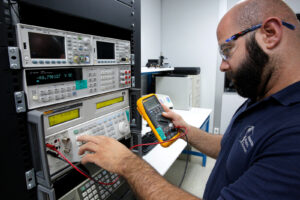

Humidity calibration is the process of comparing a humidity-measuring instrument against a known reference standard to determine its measurement accuracy and identify deviations. Accurate humidity measurement is essential in pharmaceutical manufacturing, biotechnology, laboratories, cleanrooms, environmental monitoring, manufacturing, research facilities, storage areas, and other controlled environments where relative humidity can affect products, processes, equipment, and test results.
At International Process Solutions (IPS), we provide professional calibration services for organizations that depend on reliable environmental measurements. A properly managed humidity calibration program helps facilities maintain measurement confidence, support quality systems, identify instrument drift, and maintain documented evidence that critical measuring devices are performing within established requirements.
Featured Answer: What Is Humidity Calibration?
Humidity calibration verifies the accuracy of instruments used to measure relative humidity by comparing their readings with a known reference standard under controlled conditions. The calibration process determines measurement error at specified humidity points and documents the instrument’s performance. Regular humidity calibration is important because sensors can drift over time, potentially producing inaccurate readings that affect environmental monitoring, manufacturing processes, laboratory activities, product storage, and regulatory documentation.
What Does Humidity Calibration Measure?
Humidity instruments are commonly used to measure relative humidity (RH), which is generally expressed as a percentage.
A device displaying 50% RH, for example, is reporting the amount of moisture present in the air relative to the maximum amount of moisture the air can hold under those conditions.
Humidity measurement is closely associated with temperature because temperature influences relative humidity. For this reason, many environmental monitoring instruments measure both temperature and relative humidity.
During calibration, the readings produced by the instrument under test are compared with values established using an appropriate reference standard.
The difference between the reference value and the instrument’s indication helps determine whether the device is measuring humidity within its required tolerance.
Calibration can be performed at multiple points across the instrument’s working range. Testing multiple points is particularly useful when an instrument operates across varying environmental conditions because a sensor may perform differently at low, medium, and high humidity levels.
Why Is Humidity Calibration Important?
Humidity can influence materials, products, processes, equipment, experiments, and manufacturing environments.
An inaccurate humidity sensor can create a particularly difficult problem because the displayed value may appear completely reasonable.
For example, a monitoring device could indicate that a controlled area is operating within its established humidity range even though the actual environmental conditions are outside that range.
Without periodic calibration, personnel may have limited evidence that the displayed measurement accurately represents actual conditions.
Routine humidity calibration provides documented confirmation of instrument performance and allows organizations to identify measurement drift before inaccurate readings become an ongoing quality concern.
Humidity Sensors Can Drift Over Time
Measurement instruments do not necessarily maintain their original accuracy indefinitely.
Humidity sensors can experience measurement drift as they age or are exposed to environmental and operational conditions.
Potential influences include:
- Extended use
- Sensor aging
- Contamination
- Dust and airborne particles
- Chemical exposure
- Condensation
- High-humidity environments
- Temperature extremes
- Repeated environmental cycling
- Storage conditions
- Physical damage
- Electronic component changes
The instrument may continue displaying measurements normally even when its accuracy has changed.
This is precisely why calibration is necessary.
Calibration evaluates actual measurement performance rather than assuming an instrument remains accurate because it powers on and produces a reading.
What Instruments Require Humidity Calibration?
Humidity measurement is incorporated into many types of laboratory, manufacturing, monitoring, and industrial equipment.
Common instruments that may require humidity calibration include:
- Digital hygrometers
- Humidity meters
- Relative humidity sensors
- Temperature and humidity data loggers
- Environmental monitoring devices
- Thermo-hygrometers
- Humidity transmitters
- Humidity probes
- Chart recorders
- Portable humidity meters
- Wireless environmental monitoring sensors
- Building monitoring instrumentation
The appropriate calibration procedure depends on the instrument, its measurement range, accuracy requirements, intended application, manufacturer specifications, and the organization’s quality requirements.
Humidity Calibration in Pharmaceutical Facilities
Humidity measurement can be especially important within pharmaceutical and life sciences environments.
Manufacturing areas, laboratories, cleanrooms, warehouses, stability environments, and storage locations may have defined environmental requirements.
Environmental conditions can influence raw materials, manufacturing operations, packaging components, finished products, laboratory activities, and storage conditions.
When relative humidity is identified as a controlled or monitored parameter, the instruments responsible for measuring that parameter must provide dependable information.
A facility may establish an acceptable environmental range and use sensors or data loggers to continuously monitor the area.
If those sensors are inaccurate, however, the resulting environmental records may not accurately represent the conditions that actually existed.
A structured humidity calibration program helps support confidence in those environmental monitoring records.
Humidity Calibration for Laboratories
Laboratories frequently rely on controlled environmental conditions to support consistent testing and research.
Humidity can influence certain materials, samples, instruments, weighing operations, and experimental conditions.
Laboratories may therefore monitor environmental temperature and humidity as part of routine operations.
For laboratories operating under formal quality systems, simply recording environmental conditions may not be enough. The measuring devices generating those records must also be appropriately maintained and calibrated according to established procedures.
Professional humidity calibration helps laboratories document the performance of these instruments and identify sensors requiring adjustment, repair, replacement, or further evaluation.
Humidity Calibration in Cleanrooms and Controlled Environments
Cleanrooms and controlled environments are designed to maintain specified operating conditions.
While cleanroom classifications are strongly associated with airborne particle concentrations, facilities may also establish environmental requirements for temperature, humidity, pressure, and other parameters depending on the process.
Humidity can be particularly relevant when operations involve moisture-sensitive materials, static electricity concerns, personnel comfort, manufacturing processes, or product requirements.
Environmental monitoring devices provide continuous information about these conditions.
Calibration ensures those devices are not merely collecting data—they are collecting data from instruments whose measurement performance has been evaluated against an appropriate reference.
Humidity Calibration for Manufacturing
Humidity control extends well beyond pharmaceutical and laboratory environments.
Manufacturers in numerous industries monitor humidity because moisture can influence materials and production processes.
Applications can include:
- Electronics manufacturing
- Medical device production
- Packaging operations
- Food processing
- Aerospace manufacturing
- Precision manufacturing
- Chemical processing
- Material storage
- Research and development
- Controlled warehousing
Certain materials absorb moisture readily, while others can become brittle, swell, shrink, corrode, or otherwise change when environmental conditions move outside acceptable ranges.
Reliable humidity measurements allow manufacturing teams to identify changing environmental conditions and respond according to their established procedures.
How Is Humidity Calibration Performed?
A humidity calibration generally involves exposing the instrument under test and an appropriate reference system to controlled humidity conditions.
The instrument is allowed sufficient time to stabilize before its indicated measurement is compared with the reference value.
Depending on calibration requirements, testing may be performed at several humidity levels.
For example, an organization may require calibration at low, intermediate, and high relative humidity points representative of the instrument’s normal operating range.
The exact test points should be selected according to factors such as:
- Manufacturer specifications
- Instrument operating range
- Process requirements
- Internal procedures
- Historical calibration performance
- Required measurement accuracy
- Applicable quality requirements
Testing an instrument across multiple points can provide a better understanding of its performance throughout the range in which it is actually used.
What Is the Difference Between Humidity Calibration and Humidity Verification?
Although the terms are sometimes used interchangeably, calibration and verification are not necessarily the same activity.
Calibration involves comparing an instrument’s indication with an appropriate reference to determine its measurement performance and error under defined conditions.
Verification generally determines whether an instrument satisfies specified requirements.
In practical terms, calibration provides measurement information that can then be used to determine whether the instrument meets established acceptance criteria.
Organizations should define calibration and verification activities clearly within their quality procedures to ensure consistent equipment management.
What Is a Humidity Calibration Certificate?
Following calibration, appropriate documentation provides a record of the service performed and the instrument’s measured performance.
Depending on the calibration performed and applicable requirements, documentation may include information such as:
Instrument identification: Manufacturer, model, serial number, asset number, or other identifying information.
Calibration date: The date on which calibration was performed.
Calibration points: The relative humidity conditions evaluated during calibration.
Reference information: Identification of standards or equipment used during the calibration process.
Measurement results: Recorded values showing instrument performance at the selected test points.
Technician or laboratory information: Identification associated with the calibration service.
Calibration status: Documentation relevant to the condition or results of the instrument as applicable.
Calibration records can become an important component of an organization’s overall equipment history.
How Often Should Humidity Sensors Be Calibrated?
There is no universal calibration interval appropriate for every humidity instrument or application.
Many organizations establish calibration intervals based on a combination of manufacturer recommendations, quality-system requirements, instrument usage, environmental conditions, measurement criticality, and historical performance.
A humidity sensor used in a critical pharmaceutical manufacturing environment may require a different calibration interval than a portable meter used occasionally for noncritical measurements.
Factors to consider include:
- Manufacturer recommendations
- Frequency of use
- Required accuracy
- Operating environment
- Exposure to contaminants
- Previous calibration results
- Sensor stability
- Process criticality
- Regulatory requirements
- Internal quality procedures
Historical calibration results are particularly valuable.
If an instrument repeatedly remains stable and within tolerance, that information can support calibration interval evaluations. Conversely, recurring drift or out-of-tolerance results may indicate that the instrument requires more frequent calibration, maintenance, or replacement.
What Happens When a Humidity Instrument Is Out of Tolerance?
An out-of-tolerance humidity instrument requires careful evaluation.
The immediate concern is not limited to the instrument itself. Organizations may also need to determine whether inaccurate measurements could have affected decisions, products, processes, testing, storage conditions, or previously recorded environmental data.
The appropriate response depends on the application and the organization’s procedures.
This illustrates an important reason for maintaining consistent calibration intervals: detecting measurement drift earlier can reduce the period during which questionable measurements may have been generated.
Why Calibration Documentation Matters
Calibration is both a technical and documentation-driven activity.
For regulated facilities and organizations operating under formal quality systems, documentation provides evidence that measurement equipment is being managed according to established requirements.
A strong equipment calibration program typically allows an organization to identify:
- Which instruments require calibration
- When each instrument was last calibrated
- When calibration is due
- What calibration points were tested
- What results were obtained
- Whether equipment met established criteria
- Which standards were used
- What actions were taken following unacceptable results
This creates a traceable equipment history and supports internal quality reviews, customer requirements, and regulatory inspections where applicable.
Humidity Calibration and Measurement Traceability
Measurement traceability is an important concept within professional calibration programs.
Traceability establishes a documented relationship between measurement results and appropriate reference standards through an unbroken chain of calibrations, with each contributing to measurement uncertainty.
For organizations relying on humidity measurements for critical decisions, traceable calibration provides greater confidence that measurement results are connected to recognized standards rather than being based solely on an instrument’s displayed value.
This is especially important for organizations operating within pharmaceutical, biotechnology, manufacturing, laboratory, and other quality-controlled environments.
On-Site Humidity Calibration vs. Laboratory Calibration
Depending on the instrument and application, calibration services may be performed on-site or in a calibration laboratory.
On-site calibration can be valuable for facilities managing numerous environmental monitoring instruments or equipment that is inconvenient to remove from service.
Reducing instrument transportation and coordinating calibration around facility operations can help minimize disruption.
Laboratory calibration may be appropriate when instruments can be removed from service and sent to a controlled calibration environment.
The appropriate approach depends on instrument type, required calibration capabilities, process requirements, equipment availability, and facility operations.
At International Process Solutions, we work with organizations to develop calibration service approaches that support both measurement requirements and operational needs.
Developing an Effective Humidity Calibration Program
A successful humidity calibration program begins with identifying all instruments used to make humidity-related measurements.
Organizations should determine which devices affect critical processes and establish appropriate calibration requirements for each instrument.
An effective program should consider the instrument’s:
Measurement range — the humidity levels the device is expected to measure.
Required accuracy — the level of accuracy necessary for the application.
Calibration points — the values at which instrument performance should be evaluated.
Calibration interval — how frequently calibration should occur.
Acceptance criteria — the requirements used to determine whether instrument performance is acceptable.
Equipment history — previous calibration results, repairs, adjustments, and out-of-tolerance conditions.
Managing these elements consistently helps transform calibration from a reactive maintenance activity into a structured measurement-management program.
Professional Humidity Calibration Services in California
Organizations that rely on humidity measurements need more than instruments that simply display numbers. They need confidence that those measurements accurately represent the environment being monitored.
At International Process Solutions, we provide professional calibration solutions for pharmaceutical, biotechnology, life sciences, research, educational, manufacturing, municipal, and industrial organizations throughout California.
Our services support facilities that depend on reliable measurement equipment and comprehensive calibration documentation.
We understand the importance of minimizing disruption when critical instrumentation requires service. Our calibration capabilities are designed to help organizations maintain equipment performance while supporting their operational and quality requirements.
Frequently Asked Questions About Humidity Calibration
What is humidity calibration?
Humidity calibration compares a humidity-measuring instrument with an appropriate reference standard under controlled conditions to determine measurement error and evaluate instrument performance.
Why do humidity sensors need calibration?
Humidity sensors can drift because of aging, environmental exposure, contamination, repeated use, and other factors. Calibration determines whether the sensor continues to provide measurements within required tolerances.
How often should a humidity meter be calibrated?
The appropriate frequency depends on manufacturer recommendations, usage, environmental conditions, measurement criticality, historical performance, and applicable quality requirements. Organizations should establish intervals appropriate for each application rather than assuming one interval applies to every instrument.
What is relative humidity calibration?
Relative humidity calibration evaluates the accuracy of an instrument that measures relative humidity, typically expressed as %RH, by comparing its indication with a known reference under defined environmental conditions.
Can temperature affect humidity measurements?
Yes. Relative humidity is temperature dependent, making temperature control and measurement important considerations when evaluating humidity instrumentation.
What industries require humidity calibration?
Humidity calibration is commonly used in pharmaceuticals, biotechnology, life sciences, laboratories, manufacturing, medical devices, electronics, research, warehousing, aerospace, and other controlled environments.
Can humidity calibration be performed at multiple test points?
Yes. Multiple calibration points can be used to evaluate instrument performance across the portion of its measurement range relevant to the application.
Schedule Humidity Calibration With International Process Solutions
Reliable environmental monitoring depends on reliable instruments.
A humidity sensor that has drifted from its expected performance can produce measurements that appear legitimate while inaccurately representing actual environmental conditions. Regular calibration provides the documented measurement information organizations need to evaluate instrument performance and maintain confidence in environmental data.
At International Process Solutions, we provide professional humidity calibration and instrument calibration services throughout California, supporting organizations with demanding laboratory, manufacturing, pharmaceutical, biotechnology, and industrial requirements.
Whether an organization manages a small number of portable humidity meters or a large inventory of environmental monitoring instruments, establishing an appropriate calibration program can help maintain measurement accuracy, traceability, equipment reliability, and quality-system documentation.
Contact International Process Solutions today to discuss humidity calibration services and develop a calibration solution appropriate for your facility, instruments, and operational requirements.