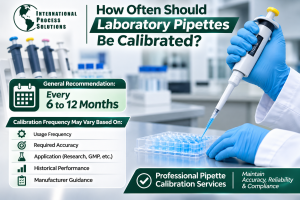

Laboratory pipettes should generally be calibrated every 6 to 12 months, although the appropriate frequency depends on usage, accuracy requirements, environmental conditions, and laboratory quality standards. Pipettes used frequently in pharmaceutical, biotechnology, clinical, and research laboratories may require calibration every 3 to 6 months, while instruments used less frequently may qualify for annual calibration. ISO 8655 provides internationally recognized requirements and methods for piston-operated volumetric apparatus, but does not establish one universal calibration interval for every pipette. At International Process Solutions (IPS), we provide professional pipette calibration services to help laboratories maintain accurate liquid measurements, establish appropriate calibration schedules, and support compliance with applicable ISO, GMP, and FDA requirements.
Regular pipette calibration is essential for maintaining consistent liquid-handling performance, reducing measurement errors, and protecting the reliability of laboratory results. Even small inaccuracies in liquid dispensing can affect analytical testing, pharmaceutical manufacturing, biotechnology research, and quality control procedures.
At International Process Solutions, we understand that laboratories depend on precise liquid measurements to maintain consistent results. We provide professional pipette calibration services in California, including recurring calibration scheduling and onsite calibration options for eligible laboratory equipment.
Why Is Regular Laboratory Pipette Calibration Important?
Pipettes are among the most frequently used measuring instruments in modern laboratories. They are essential for transferring precise liquid volumes during analytical testing, sample preparation, chemical analysis, molecular biology, pharmaceutical development, and scientific research.
Over time, pipettes may experience mechanical wear, seal deterioration, piston contamination, or changes in dispensing performance. These conditions can cause the actual volume delivered to differ from the selected volume.
Pipette calibration evaluates the instrument’s liquid-delivery performance against established measurement references and determines whether it meets specified accuracy and precision requirements.
Without routine calibration, laboratories may unknowingly use instruments that produce inaccurate results.
How Inaccurate Pipettes Affect Laboratory Results
An improperly calibrated pipette can introduce measurement errors into critical laboratory procedures.
Potential consequences include:
-
Inaccurate sample preparation: Incorrect liquid volumes can change reagent concentrations and sample ratios.
-
Unreliable analytical results: Measurement errors may affect quantitative laboratory testing.
-
Reduced experimental reproducibility: Inconsistent liquid dispensing can increase variability between experiments.
-
Compromised quality control: Incorrect measurements may affect product acceptance decisions.
-
Regulatory documentation issues: Missing or inadequate calibration records can create audit findings.
-
Increased operating costs: Failed experiments and repeated testing can waste reagents, materials, and labor.
-
Product quality risks: Incorrect liquid volumes may affect manufacturing and testing processes.
At International Process Solutions, we help laboratories minimize these risks through professional calibration services designed to support dependable liquid-handling performance.
What Is the Recommended Pipette Calibration Frequency?
The recommended calibration interval depends on how the pipette is used, the accuracy required, and the laboratory’s quality management system.
Although many laboratories begin with a 6- or 12-month calibration schedule, the interval should be evaluated against actual instrument performance and operational requirements.
Recommended Pipette Calibration Schedule by Usage
| Pipette Usage | Example Calibration Interval | Considerations |
|---|---|---|
| Heavy daily use | Every 3 months | High usage, demanding applications, or critical measurements |
| Regular laboratory use | Every 6 months | Frequently used pipettes requiring consistent performance |
| Moderate use | Every 6–12 months | Routine laboratory applications |
| Occasional use | Every 12 months | Limited use under controlled conditions |
| Critical pharmaceutical applications | Every 3–6 months | Risk-based intervals based on validated process requirements |
| After repair or adjustment | Before returning to service | Verify performance following work affecting measurement accuracy |
| After suspected damage | Before further critical use | Evaluate potential measurement errors |
These are illustrative starting intervals, not universal requirements. Actual schedules should be established through documented risk assessment, manufacturer guidance, historical performance, and applicable quality requirements.
Is Annual Pipette Calibration Enough?
Annual pipette calibration may be appropriate for instruments used under controlled conditions with demonstrated measurement stability.
However, laboratories performing frequent or high-precision liquid-handling procedures may require shorter intervals.
For example, a pipette used occasionally for noncritical sample preparation may have different calibration requirements than one used repeatedly for pharmaceutical quality control testing.
At International Process Solutions, we help customers coordinate calibration services according to their established equipment requirements and scheduling needs.
What Factors Determine How Often Pipettes Need Calibration?
Several factors influence the appropriate calibration frequency for laboratory pipettes.
Understanding these variables helps laboratories establish calibration schedules that maintain measurement reliability without creating unnecessary service interruptions.
1. Frequency of Pipette Use
Pipettes used repeatedly throughout the day experience more mechanical activity than instruments used occasionally.
Frequent piston movement, tip attachment, and repeated dispensing cycles can contribute to component wear.
Laboratories with high-volume testing operations may benefit from shorter calibration intervals and additional performance checks between formal calibrations.
2. Required Measurement Accuracy
Applications requiring extremely precise liquid volumes may demand more frequent calibration.
For example, pipettes used in quantitative analytical testing, pharmaceutical research, and sensitive molecular biology applications may have tighter performance requirements than those used for general laboratory preparation.
The appropriate interval should reflect the measurement uncertainty and tolerances required for the intended application.
3. Pipette Manufacturer Recommendations
Manufacturers provide maintenance and calibration guidance based on instrument design, intended use, and expected operating conditions.
These recommendations can provide a useful starting point for developing a calibration schedule.
However, laboratories should also evaluate actual instrument performance and applicable quality requirements.
4. Environmental Conditions
Temperature, humidity, atmospheric pressure, and other environmental factors can influence liquid-handling measurements.
Temperature differences between the pipette, liquid, and surrounding environment may affect volumetric performance.
Proper calibration conditions are especially important when using gravimetric methods, which determine liquid volume from measured mass and appropriate conversion factors.
5. Pipette Age and Mechanical Condition
Older pipettes may require closer monitoring as seals, pistons, springs, and other components experience wear.
Instruments with repeated calibration failures or performance instability may require maintenance, shorter calibration intervals, or replacement.
6. Previous Calibration Results
Historical calibration records provide valuable information about instrument stability.
A pipette that consistently performs within established tolerances may support maintaining its existing calibration interval.
Conversely, repeated measurement drift or out-of-tolerance results may indicate the need for more frequent calibration.
7. Regulatory and Quality Requirements
Laboratories operating under GMP, GLP, ISO/IEC 17025, or other applicable quality systems must establish calibration practices appropriate to their equipment and intended use.
Specific customer requirements, internal procedures, or validated processes may also determine calibration frequency.
What Does ISO 8655 Say About Pipette Calibration?
ISO 8655 is an internationally recognized series of standards addressing piston-operated volumetric apparatus, including pipettes.
The standards establish requirements and procedures relevant to volumetric performance and measurement evaluation.
ISO 8655 is particularly important for laboratories that require standardized methods for evaluating pipette performance.
Important ISO 8655 Requirements
Relevant parts of the ISO 8655 series address topics such as:
-
General requirements for piston-operated volumetric apparatus.
-
Requirements for piston pipettes.
-
Reference measurement procedures.
-
Gravimetric measurement methods.
-
Photometric measurement methods.
-
Measurement uncertainty.
-
Maximum permissible errors for applicable equipment.
-
Calibration and testing conditions.
The appropriate requirements depend on the instrument type, applicable standard edition, and calibration method.
Does ISO 8655 Require Pipette Calibration Every Six Months?
No. ISO 8655 does not establish a universal requirement that every laboratory pipette must be calibrated every six months.
Laboratories should determine calibration intervals based on equipment use, performance history, required accuracy, and applicable quality system requirements.
A six-month interval may be appropriate for many laboratory applications, but it should not be treated as a mandatory interval for every pipette.
At International Process Solutions, we provide professional pipette calibration services that support customers seeking measurement practices aligned with applicable technical standards.
How Is Laboratory Pipette Calibration Performed?
Professional pipette calibration evaluates the relationship between the selected liquid volume and the volume actually delivered by the instrument.
One widely used approach is the gravimetric calibration method, which measures the mass of dispensed water and converts that mass into volume using appropriate correction factors.
Step 1: Inspect the Pipette
Before calibration, the instrument is inspected for visible damage or conditions that may affect performance.
Inspection may include evaluating:
-
Pipette body condition.
-
Piston movement.
-
Tip attachment.
-
Seals and internal components.
-
Volume adjustment mechanisms.
-
Evidence of contamination or leakage.
A damaged or malfunctioning pipette may require maintenance before further testing.
Step 2: Establish Controlled Calibration Conditions
Gravimetric pipette calibration requires suitable environmental conditions and properly maintained measurement equipment.
Relevant conditions may include:
-
Ambient temperature.
-
Water temperature.
-
Relative humidity.
-
Atmospheric pressure.
-
Balance performance.
-
Evaporation control.
These factors help ensure that calibration results accurately reflect instrument performance.
Step 3: Dispense a Known Test Volume
The technician selects appropriate test volumes according to the calibration method and instrument specifications.
Variable-volume pipettes are commonly evaluated at multiple points across their operating range.
For example, a variable-volume pipette with a nominal capacity of 1,000 microliters may be evaluated at representative low, intermediate, and maximum-volume settings, as specified by the applicable procedure.
Step 4: Measure the Dispensed Liquid
A suitable analytical balance measures the mass of the dispensed water.
The measured mass is converted into volume using appropriate corrections that account for relevant physical conditions.
Step 5: Calculate Measurement Error and Repeatability
Calibration results are evaluated to determine the pipette’s performance.
Two important characteristics are:
Systematic error: The difference between the average delivered volume and the selected volume.
Random error: The variability observed among repeated dispensing measurements.
These values help determine whether the pipette satisfies established performance requirements.
Step 6: Evaluate Results Against Acceptance Criteria
Calibration results are compared with the applicable tolerances or acceptance limits.
A pipette that does not meet the specified requirements may require adjustment, maintenance, repair, or replacement.
Step 7: Document Calibration Results
The calibration provider prepares documentation appropriate to the service performed.
This documentation supports equipment traceability, laboratory quality management, and future calibration planning.
What Is the Difference Between Pipette Calibration and Pipette Verification?
Although calibration and verification are closely related, they are not identical.
Pipette calibration establishes the relationship between selected volumes and measured delivered volumes under specified conditions.
Pipette verification determines whether the instrument satisfies established performance requirements.
A laboratory may use periodic verification checks between scheduled calibrations to monitor pipette performance.
When Should Pipettes Be Verified Between Calibrations?
Additional verification may be appropriate when:
-
A pipette is used for critical measurements.
-
An instrument experiences unusually heavy use.
-
The pipette has been dropped or damaged.
-
Dispensing performance appears inconsistent.
-
The pipette has undergone maintenance.
-
The laboratory requires additional quality control checks.
Verification does not automatically replace scheduled calibration. The laboratory should determine how each activity fits into its documented measurement management program.
How Do I Know if My Laboratory Pipette Needs Calibration?
Pipettes may experience gradual performance changes without obvious external signs.
However, certain conditions indicate that an instrument should be evaluated before continued critical use.
Common Signs of Pipette Calibration Problems
Inconsistent Dispensing Volumes
Repeated measurements produce greater variation than expected.
Liquid Leakage
Liquid escapes from the tip or the instrument does not maintain proper aspiration.
Unusual Piston Resistance
The plunger feels unusually stiff, loose, or inconsistent during operation.
Visible Damage
Cracks, worn components, or damaged seals may affect performance.
Unexpected Laboratory Results
Repeated analytical inconsistencies may indicate liquid-handling errors, although other causes should also be investigated.
Failed Performance Checks
Routine verification identifies measurement results outside established acceptance limits.
Recent Repair or Adjustment
Maintenance affecting volumetric performance may require calibration before the instrument returns to service.
At International Process Solutions, we provide pipette calibration services to help laboratories evaluate instrument accuracy and identify measurement performance concerns.
How Often Should Pipettes Be Calibrated in Pharmaceutical Laboratories?
Pharmaceutical laboratories often require carefully controlled liquid measurements to support analytical testing, formulation development, quality control, and regulated manufacturing processes.
Calibration intervals should reflect the instrument’s role in these activities.
Pipette Calibration for GMP Laboratories
Laboratories operating under applicable Good Manufacturing Practice (GMP) requirements must maintain appropriate controls over instruments used for regulated testing.
For example, 21 CFR 211.160(b)(4) addresses calibration of instruments, apparatus, gauges, and recording devices used in laboratory controls at suitable intervals according to an established written program.
This requirement does not prescribe one universal pipette calibration frequency.
Instead, organizations must establish appropriate intervals based on their processes, equipment requirements, and quality systems.
Recommended Practices for Pharmaceutical Pipettes
Pharmaceutical laboratories should consider:
-
Documented calibration schedules.
-
Equipment identification and status.
-
Defined performance tolerances.
-
Appropriate measurement traceability.
-
Controlled calibration procedures.
-
Historical performance reviews.
-
Out-of-tolerance investigations.
-
Verification after relevant maintenance.
-
Complete calibration documentation.
For critical liquid-handling applications, shorter calibration intervals may be justified based on risk and historical performance.
At International Process Solutions, we support pharmaceutical and biotechnology facilities with professional pipette calibration services and recurring scheduling options.
How Often Should Pipettes Be Calibrated in Research and Biotechnology Laboratories?
Research and biotechnology laboratories frequently use pipettes for sample preparation, molecular biology, analytical chemistry, and experimental procedures.
The required calibration frequency depends on the sensitivity of the application and the laboratory’s measurement requirements.
Pipette Calibration for Molecular Biology
Pipettes used for PCR, DNA analysis, RNA preparation, and other molecular biology procedures may dispense extremely small liquid volumes.
Small volumetric errors can affect reagent concentrations and experimental consistency.
Laboratories should evaluate calibration frequency according to instrument usage, volume range, and required measurement performance.
Pipette Calibration for Biotechnology Research
Biotechnology laboratories may use pipettes for cell culture preparation, protein analysis, reagent dispensing, and analytical testing.
Instruments used for high-frequency or critical procedures may require more frequent calibration than those used for general laboratory tasks.
Pipette Calibration for Academic Research Laboratories
University and research laboratories may operate large inventories of pipettes shared among multiple users.
Frequent handling and varying user techniques can increase the need for routine inspections and performance checks.
A centralized calibration schedule can help maintain consistency across departments and research groups.
Should Single-Channel and Multichannel Pipettes Have Different Calibration Schedules?
Single-channel and multichannel pipettes may require different performance evaluations because of their mechanical design and intended use.
Single-Channel Pipette Calibration
Single-channel pipettes dispense liquid through one channel.
Calibration evaluates the instrument’s volumetric performance at specified test volumes.
These instruments are commonly used for sample preparation, reagent transfer, and routine laboratory procedures.
Multichannel Pipette Calibration
Multichannel pipettes dispense liquid through multiple channels simultaneously.
Calibration may require evaluating individual channels to identify differences in delivered volume.
A multichannel pipette can exhibit acceptable average performance while one or more channels operate outside specified limits.
For this reason, appropriate multichannel calibration procedures should evaluate the required channel-specific performance characteristics.
Calibration intervals for both instrument types should be based on actual usage, historical performance, and measurement requirements rather than channel count alone.
What Happens if a Pipette Fails Calibration?
A pipette that fails established calibration acceptance criteria should be evaluated before returning to critical laboratory use.
Common Causes of Pipette Calibration Failure
Potential causes include:
-
Worn piston seals.
-
Damaged internal components.
-
Improper tip sealing.
-
Mechanical wear.
-
Contamination.
-
Incorrect adjustment.
-
Physical damage.
-
Improper maintenance.
-
Environmental influences during measurement.
What Should Laboratories Do With an Out-of-Tolerance Pipette?
Organizations should follow a documented process that may include:
-
Removing the instrument from service.
-
Recording the failed calibration results.
-
Evaluating potential effects on previous laboratory measurements.
-
Identifying possible causes.
-
Performing appropriate maintenance or adjustment.
-
Recalibrating the instrument when necessary.
-
Documenting the final equipment status.
For regulated laboratories, an out-of-tolerance condition may also require a formal impact assessment or corrective action investigation.
Maintaining historical calibration records can help determine whether performance deterioration occurred gradually or resulted from a specific event.
Can Pipette Calibration Be Scheduled in Advance?
Yes. Pipette calibration services can be prescheduled to help laboratories maintain consistent calibration intervals and reduce overdue equipment.
At International Process Solutions, we work with customers to coordinate recurring calibration appointments based on their established equipment schedules.
Benefits of Prescheduled Pipette Calibration
Reduced Administrative Work
Recurring appointments reduce the need to arrange each calibration individually.
Improved Equipment Availability
Laboratories can plan calibration activities around testing schedules and operational requirements.
Fewer Overdue Instruments
Advance scheduling helps reduce the likelihood of missed calibration deadlines.
Consistent Documentation
Regular service appointments support organized equipment histories and calibration records.
Better Laboratory Planning
Facilities can coordinate calibration activities with maintenance, quality audits, and laboratory operations.
We support annual, semiannual, quarterly, and other recurring calibration scheduling arrangements based on customer requirements and service availability.
Can Laboratory Pipettes Be Calibrated Onsite?
Onsite pipette calibration allows eligible instruments to be calibrated at the customer’s facility when suitable equipment and environmental conditions are available.
This approach can be particularly beneficial for laboratories with extensive pipette inventories.
Advantages of Onsite Pipette Calibration
-
Reduced equipment shipping requirements.
-
Lower risk of transportation-related damage.
-
Coordinated calibration of multiple instruments.
-
Reduced administrative handling.
-
Convenient scheduling around laboratory operations.
-
Potentially shorter equipment downtime.
However, onsite gravimetric calibration requires suitable environmental conditions, measurement equipment, and procedures.
The availability of onsite calibration depends on the required calibration method, measurement uncertainty, instrument type, and facility conditions.
At International Process Solutions, we provide onsite laboratory calibration services throughout California for eligible equipment, helping laboratories coordinate their calibration needs efficiently.
How Much Does Laboratory Pipette Calibration Cost?
The cost of pipette calibration varies depending on the instrument type, calibration requirements, number of test points, service location, and documentation needs.
Factors Affecting Pipette Calibration Pricing
| Factor | Potential Cost Consideration |
|---|---|
| Single-channel pipette | Number of test volumes and measurements |
| Multichannel pipette | Number of channels requiring evaluation |
| Fixed-volume pipette | Applicable calibration procedure |
| Variable-volume pipette | Multiple volume settings |
| Accredited calibration | Required accredited scope and uncertainty |
| Onsite calibration | Travel, setup, and equipment quantity |
| Repair or adjustment | Additional corrective services |
| Expedited turnaround | Scheduling and service availability |
Laboratories managing large pipette inventories may benefit from coordinating multiple instruments during a single service appointment.
At International Process Solutions, we work with customers to determine appropriate calibration service arrangements based on their equipment and operational requirements.
How Can Laboratories Create an Effective Pipette Calibration Program?
A structured pipette calibration program helps laboratories maintain measurement accuracy and ensure instruments remain suitable for their intended applications.
Step 1: Create a Pipette Inventory
Document each instrument’s manufacturer, model, serial number, volume range, department, and assigned user or location.
Step 2: Establish Calibration Intervals
Determine appropriate intervals based on usage, performance history, manufacturer recommendations, and measurement criticality.
Step 3: Define Acceptance Criteria
Establish performance requirements appropriate to the instrument and application.
Step 4: Select a Qualified Calibration Provider
Choose a laboratory with suitable technical capabilities, measurement traceability, and accreditation coverage when required.
Step 5: Implement Calibration Tracking
Maintain a centralized system for recording calibration dates, due dates, certificates, and equipment status.
Step 6: Schedule Recurring Calibration
Arrange calibration appointments sufficiently in advance to avoid overdue instruments.
Step 7: Review Historical Results
Monitor calibration performance to identify instruments showing measurement drift or recurring problems.
Step 8: Investigate Calibration Failures
Document out-of-tolerance conditions and evaluate potential effects on previous measurements.
Step 9: Train Laboratory Personnel
Ensure employees understand proper pipetting techniques, equipment handling, and procedures for reporting damaged instruments.
Step 10: Review the Program Regularly
Evaluate calibration intervals and procedures to ensure they remain appropriate for laboratory requirements.
At International Process Solutions, we support laboratories with professional calibration services and scheduling arrangements that help simplify ongoing equipment management.
Frequently Asked Questions About Laboratory Pipette Calibration
Do Pipettes Need to Be Calibrated Every Year?
Many laboratories use annual pipette calibration schedules. However, frequently used or critical instruments may require calibration every three to six months. The appropriate interval depends on usage, historical performance, required accuracy, and applicable quality requirements.
Is Pipette Calibration Required Every Six Months?
No universal requirement mandates six-month calibration for every laboratory pipette. Six-month intervals are common in some laboratories, but calibration schedules should be established according to equipment-specific requirements and documented risk assessments.
How Often Should Micropipettes Be Calibrated?
Micropipettes are commonly calibrated every 6 to 12 months, although high-use or critical applications may justify shorter intervals. Small-volume measurements can be particularly sensitive to technique, environmental conditions, and instrument performance.
Does ISO 8655 Specify a Calibration Frequency?
ISO 8655 establishes technical requirements and methods for piston-operated volumetric apparatus but does not prescribe one universal calibration interval for every pipette.
Should Pipettes Be Calibrated After Repair?
Yes. Repairs or adjustments that may affect volumetric performance should be followed by appropriate calibration or performance evaluation before the pipette returns to critical use.
Can I Calibrate Pipettes Myself?
Laboratories may perform internal calibration when they possess suitable equipment, validated or verified methods, qualified personnel, appropriate environmental controls, and measurement traceability.
Organizations requiring externally accredited calibration should verify that their internal capabilities satisfy the applicable requirements.
What Is the Difference Between Pipette Accuracy and Precision?
Accuracy describes how closely delivered volumes agree with the intended volume, while precision describes the consistency of repeated dispensing measurements.
A pipette can deliver consistent volumes while still exhibiting systematic measurement error.
Can Pipette Calibration Be Performed at My Laboratory?
Yes. Onsite pipette calibration may be available when the required environmental conditions and measurement equipment can be provided.
International Process Solutions offers onsite calibration services for eligible laboratory equipment throughout California.
What Happens if I Use an Uncalibrated Pipette?
Using a pipette without appropriate calibration controls increases the risk of undetected measurement errors. Depending on the application, these errors may affect laboratory results, product quality, or compliance with documented procedures.
Can I Schedule Quarterly Pipette Calibration Services?
Yes. International Process Solutions works with customers to coordinate quarterly, semiannual, annual, and other recurring calibration appointments based on equipment requirements and service availability.
Professional Pipette Calibration Services From International Process Solutions
At International Process Solutions (IPS), we understand that reliable liquid-handling measurements are essential for laboratory accuracy, product quality, and scientific research.
We provide professional pipette calibration services for pharmaceutical companies, biotechnology laboratories, research facilities, manufacturing operations, and other organizations throughout California.
Our services support laboratories requiring dependable instrument performance and organized calibration documentation.
Our Laboratory Calibration Services Include
-
Single-channel pipette calibration
-
Multichannel pipette calibration
-
Micropipette calibration
-
Laboratory equipment calibration
-
ISO/IEC 17025 accredited calibration within our applicable scope
-
Onsite calibration services
-
Annual and quarterly calibration scheduling
-
Recurring calibration appointments
-
Emergency and on-demand calibration support
We also provide calibration services for additional laboratory and industrial instruments, including spectrophotometers, centrifuges, torque wrenches, multimeters, and humidity measurement equipment.
Pipette Calibration Services in Southern California
We support laboratories throughout Southern California, including Orange County, Irvine, San Diego, and surrounding communities.
Our calibration services help pharmaceutical, biotechnology, and research organizations maintain reliable measurement equipment and coordinate recurring service requirements.
Pipette Calibration Services in Northern California
International Process Solutions also serves laboratories throughout Northern California, including the San Carlos area and surrounding biotechnology and research markets.
Organizations with multiple laboratory instruments can contact our team to discuss calibration requirements, equipment compatibility, and available service arrangements.
Schedule Your Laboratory Pipette Calibration With International Process Solutions
Maintaining an appropriate pipette calibration schedule is essential for accurate liquid measurements, consistent laboratory performance, and dependable quality control.
Whether your laboratory requires calibration every three months, six months, or annually, establishing a documented schedule helps reduce measurement risks and prevent overdue equipment.
At International Process Solutions, we help laboratories coordinate professional pipette calibration services according to their equipment requirements and operational schedules.
Our team provides support for individual instruments, recurring calibration appointments, and coordinated onsite calibration services for eligible laboratory equipment.
Keep your laboratory pipettes accurate, reliable, and ready for critical measurements.
Visit www.ips-us.com to learn more about our laboratory calibration services, request a calibration quote, or schedule your next pipette calibration appointment.
International Process Solutions — Professional Pipette Calibration Services for Laboratories Throughout California.