
Pipettes are among the most frequently used measuring instruments in laboratories, and even small inaccuracies can affect experimental results, sample preparation, quality control, and regulatory documentation. Establishing an appropriate pipette calibration frequency is therefore an essential part of maintaining reliable laboratory operations.
At International Process Solutions, we provide professional pipette calibration services designed to help laboratories maintain accurate liquid handling equipment, document instrument performance, and support their quality and compliance requirements.
Featured Answer: How Often Should Pipettes Be Calibrated?
Pipettes should generally be calibrated at least once every 6 to 12 months, although laboratories with high-use pipettes, strict quality requirements, critical testing applications, or demanding operating conditions may require calibration every 3 to 6 months or more frequently. The correct calibration interval should be determined by pipette usage, manufacturer recommendations, laboratory procedures, historical calibration results, environmental conditions, and applicable regulatory or accreditation requirements.
A fixed annual schedule may be appropriate for some laboratories, but it should not automatically be applied to every pipette. Laboratories should establish calibration intervals based on the level of risk associated with inaccurate liquid measurements.
What Is Pipette Calibration?
Pipette calibration is the process of evaluating the volume delivered by a pipette and comparing its actual performance with defined acceptance criteria.
For an air-displacement or positive-displacement pipette, calibration helps determine whether the instrument delivers volumes with acceptable accuracy and precision.
Accuracy describes how closely the delivered volume corresponds to the intended volume. Precision describes how consistently the pipette can reproduce that volume over repeated measurements.
A pipette may appear to function normally while still delivering an incorrect volume. Mechanical wear, seal deterioration, contamination, improper handling, temperature conditions, and repeated use can gradually change pipette performance without creating an obvious mechanical failure.
Routine calibration allows these problems to be identified before they significantly affect laboratory processes.
What Is the Recommended Pipette Calibration Frequency?
For many laboratories, a 6- to 12-month calibration interval provides a practical starting point. However, the appropriate frequency depends heavily on how the pipette is used.
A laboratory may establish intervals such as:
- Every 12 months for lightly or moderately used pipettes performing lower-risk work.
- Every 6 months for routinely used pipettes involved in analytical, research, quality control, or regulated laboratory activities.
- Every 3 to 6 months for heavily used pipettes or instruments supporting critical measurements.
- More frequently than every 3 months when pipettes experience extremely high usage, demanding conditions, repeated performance problems, or applications where small volumetric errors create substantial risk.
Calibration frequency should therefore be considered an instrument-specific and application-specific decision, rather than simply applying the same schedule to every pipette in the laboratory.
Why Pipette Calibration Frequency Matters
Microliter-scale measurements leave relatively little room for error. A small volumetric deviation can become significant when a pipette is used for standards, reagents, serial dilutions, assay preparation, sample preparation, or other quantitative laboratory procedures.
Consider a procedure requiring repeated transfers of a specific volume. If the pipette systematically under-delivers or over-delivers, the error can be introduced repeatedly throughout the workflow.
This becomes particularly important in applications involving:
- Pharmaceutical testing
- Biotechnology
- Life sciences
- Clinical and research laboratories
- Quality control
- Analytical chemistry
- Microbiology
- Molecular biology
- Environmental laboratories
- Manufacturing laboratories
- Educational and research institutions
An appropriate pipette calibration schedule provides documented evidence that pipettes are being routinely evaluated rather than assumed to remain accurate indefinitely.
How Pipette Usage Affects Calibration Intervals
Usage frequency is one of the most important considerations when determining how often a pipette should be calibrated.
A pipette used several times per month does not experience the same mechanical workload as one used hundreds of times every day.
Repeated pipetting cycles can contribute to wear involving internal components, including seals, pistons, O-rings, springs, and other mechanical parts. Heavy use may therefore justify shorter calibration intervals.
Laboratories should evaluate not only how frequently a pipette is used but also how critical its measurements are.
A frequently used pipette involved in preliminary or noncritical work may present less risk than a moderately used pipette responsible for preparing calibration standards or performing quantitative testing.
High-Use Pipettes May Need More Frequent Calibration
High-volume laboratory operations should consider whether six- or twelve-month intervals provide sufficient control for heavily used pipettes.
For example, pipettes routinely used for:
- Repetitive sample preparation
- Serial dilutions
- Assay preparation
- Standards preparation
- Pharmaceutical testing
- Quality-control testing
- PCR-related workflows
- Cell culture applications
- Analytical procedures
may warrant shorter intervals.
Historical calibration results are particularly useful when determining whether a shorter schedule is justified.
If a pipette repeatedly approaches tolerance limits between calibrations, shortening the interval can help identify performance changes earlier.
When Should a Pipette Be Calibrated Immediately?
Scheduled calibration should not be the only time a pipette’s performance is evaluated.
A pipette may require immediate calibration or performance verification following certain events.
These include:
After a Pipette Is Dropped
A pipette that has been dropped or subjected to a significant impact should not automatically be assumed to remain within tolerance. Internal components can shift or become damaged even when no external damage is visible.
After Repair or Major Maintenance
Repairs involving components that influence volume delivery should generally be followed by appropriate testing or calibration before the pipette returns to critical service.
When Results Become Inconsistent
Unexpected laboratory results, poor repeatability, unusual assay behavior, or inconsistent sample preparation may indicate a liquid-handling problem.
The pipette should be included in the investigation when volumetric accuracy could reasonably contribute to the problem.
When the Pipette Begins Leaking
Leakage may indicate problems involving seals, pistons, tips, or other components. A pipette exhibiting leakage should be inspected rather than continuing to be used until its next scheduled calibration.
Following Contamination or Improper Handling
Exposure to incompatible chemicals, contamination, improper cleaning, or other unusual events can affect pipette performance.
Before Critical Work When Performance Is Uncertain
If the calibration status or performance history of a pipette cannot be verified, laboratories should consider having the instrument evaluated before using it for critical quantitative work.
Accuracy vs. Precision in Pipette Calibration
Understanding the difference between accuracy and precision is essential when evaluating pipette performance.
Pipette Accuracy
Accuracy indicates how close the delivered volume is to the selected or nominal volume.
For example, when a pipette is set to deliver 100 µL, testing determines how closely its actual delivered volume corresponds to that target.
Pipette Precision
Precision evaluates repeatability.
A pipette could repeatedly deliver nearly the same volume but still consistently deliver too much or too little. In that situation, the pipette may demonstrate good precision while having unacceptable accuracy.
Conversely, average delivery might appear close to the target while individual measurements vary excessively.
A proper pipette calibration program should therefore consider both systematic and random measurement error.
How Is Pipette Calibration Performed?
One commonly used approach to pipette calibration is the gravimetric method.
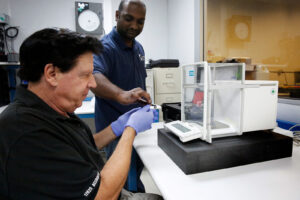
With gravimetric testing, controlled quantities of water are dispensed and weighed using an appropriate balance. The measured mass is then used to determine the corresponding volume while accounting for relevant measurement conditions.
Proper pipette calibration requires control and consideration of factors that can influence the measurement, including:
- Water temperature
- Air temperature
- Atmospheric pressure
- Relative humidity
- Evaporation
- Balance performance
- Pipetting technique
- Test volume
- Pipette condition
This is why simply dispensing liquid into a container and visually inspecting the result is not equivalent to a controlled calibration.
Should Pipettes Be Calibrated at Multiple Volumes?
Variable-volume pipettes should be appropriately evaluated across their operating range according to the applicable procedure, specifications, and calibration requirements.
Testing only one point may not fully represent how the pipette performs throughout its usable range.
For example, a variable-volume pipette can potentially perform acceptably at one setting while exhibiting greater error at another.
Laboratories should establish calibration procedures that adequately evaluate the portions of the pipette’s range that are important to its intended use.
Pipette Calibration and ISO 8655
ISO 8655 is an important international standard associated with piston-operated volumetric apparatus and provides requirements and procedures relevant to devices such as piston pipettes.
Laboratories establishing pipette calibration programs should determine which standards, manufacturer specifications, quality procedures, and regulatory requirements apply to their particular operations.
Where ISO 8655-based procedures are required, calibration should be performed using appropriate methods, equipment, environmental controls, and documented processes.
Does ISO/IEC 17025 Matter for Pipette Calibration?
For laboratories requiring strong measurement traceability and formal calibration documentation, working with an ISO/IEC 17025 accredited calibration laboratory can be important.
ISO/IEC 17025 addresses the competence of testing and calibration laboratories and includes requirements related to areas such as measurement traceability, equipment, methods, personnel competence, reporting, and measurement uncertainty.
At International Process Solutions, our pipette calibration capabilities support laboratories that require professional calibration and documentation for their quality systems.
When selecting a calibration provider, laboratories should confirm that the provider’s accredited scope covers the specific calibration service required, rather than relying solely on a general statement that the organization holds accreditation.
Pipette Calibration in Pharmaceutical and Biotechnology Laboratories
Pharmaceutical and biotechnology environments frequently require greater control over measuring equipment because pipette performance can directly affect critical laboratory processes.
Pipettes may be involved in:
- Sample preparation
- Analytical testing
- Quality-control testing
- Standards preparation
- Reagent preparation
- Assay development
- Research and development
- Method validation
- Microbiological testing
- Biotechnology workflows
For these laboratories, calibration intervals should align with documented quality procedures and the risk associated with inaccurate measurements.
A high-use pipette involved in critical quantitative testing may justify substantially more frequent calibration than a lightly used pipette performing noncritical laboratory tasks.
Can Pipette Calibration Intervals Be Extended?
Calibration intervals should not be extended simply to reduce service frequency.
However, laboratories can use historical calibration data as part of a risk-based evaluation of instrument stability.
If a pipette repeatedly demonstrates stable performance well within established acceptance criteria, the laboratory may have evidence to support its existing interval or, where permitted by its quality system, evaluate whether another interval is appropriate.
Conversely, repeated adjustments, failures, or near-tolerance results can indicate that the existing interval is too long.
Calibration history therefore provides valuable information for developing a scientifically defensible pipette management program.
How to Establish a Pipette Calibration Schedule
An effective calibration schedule should include more than a date on a sticker.
We recommend maintaining records that identify:
- Pipette manufacturer
- Model
- Serial number or unique equipment ID
- Volume range
- Department or laboratory location
- Intended application
- Calibration date
- Next calibration due date
- Calibration results
- Adjustments or repairs
- As-found and as-left condition, when applicable
- Calibration certificate
- Service history
- Out-of-tolerance history
This information allows laboratories to identify patterns and adjust calibration intervals when necessary.
What Happens If a Pipette Fails Calibration?
An out-of-tolerance pipette may require more than adjustment and return to service.
Depending on the laboratory’s quality system and the significance of the error, an investigation may be needed to determine whether previously generated results could have been affected.
Important considerations can include:
- Magnitude of the pipette error
- Direction of the error
- Previous acceptable calibration date
- Work performed since the previous calibration
- Volume settings used
- Measurement criticality
- Acceptance limits of affected methods
- Whether other controls would have detected the error
Maintaining complete pipette calibration records makes this type of investigation significantly more manageable.
Pipette Calibration vs. Routine Performance Checks
Routine internal checks and professional calibration serve different purposes.
Laboratories may perform intermediate performance checks between formal calibrations to identify potential problems early. These checks can be especially valuable for high-use or high-risk pipettes.
However, an internal verification should not automatically be considered equivalent to a formal calibration when accredited calibration or specific documentation is required.
A comprehensive pipette management program may therefore combine:
scheduled calibration + routine inspection + preventive maintenance + intermediate performance verification.
Signs Your Pipette May Need Calibration or Service
Laboratory personnel should watch for performance changes between scheduled calibrations.
Potential warning signs include:
- Inconsistent dispensing
- Liquid leakage
- Dripping from the tip
- Difficulty aspirating liquid
- Unusual plunger resistance
- Changes in plunger movement
- Poor repeatability
- Unexpected assay results
- Physical damage
- Difficulty attaching tips properly
- Volume adjustment problems
- Visible contamination
A pipette exhibiting abnormal behavior should be evaluated promptly rather than waiting for its scheduled calibration date.
How Proper Pipette Handling Helps Maintain Accuracy
Calibration establishes performance at a specific point in time, but everyday handling can influence how well that performance is maintained.
Laboratories should train personnel to use pipettes consistently and according to manufacturer recommendations.
Good practices include storing pipettes appropriately, using compatible tips, avoiding unnecessary mechanical shock, following proper aspiration and dispensing techniques, maintaining appropriate pipetting angles, and cleaning equipment according to established procedures.
Proper handling does not eliminate the need for calibration, but it can help reduce unnecessary wear and performance problems.
Frequently Asked Questions About Pipette Calibration
How Often Should Laboratory Pipettes Be Calibrated?
Many laboratories calibrate pipettes every 6 to 12 months. High-use, high-risk, or critical pipettes may require calibration every 3 to 6 months or more frequently, depending on applicable requirements and performance history.
Is Annual Pipette Calibration Enough?
Annual calibration may be appropriate for some pipettes, particularly those with moderate or limited use and a history of stable performance. It may be insufficient for heavily used or critical pipettes.
Should a New Pipette Be Calibrated?
Laboratories should verify that newly acquired pipettes meet their required performance and documentation criteria before placing them into critical service. Manufacturer documentation alone may not satisfy every laboratory’s quality-system requirements.
Should a Pipette Be Calibrated After It Is Dropped?
A significant drop or impact can affect pipette performance. The pipette should be inspected and, when appropriate, tested or calibrated before returning to critical use.
How Often Should High-Use Pipettes Be Calibrated?
Pipettes used continuously in production, pharmaceutical, biotechnology, quality-control, or other demanding environments may require calibration every three to six months, depending on historical performance and the laboratory’s risk assessment.
Can Pipettes Become Inaccurate Between Calibrations?
Yes. Wear, mechanical damage, contamination, seal deterioration, improper handling, environmental conditions, and other factors can affect pipette performance between scheduled calibration dates.
Do Pipettes Need Preventive Maintenance?
Routine maintenance can be an important component of a pipette management program. Maintenance requirements depend on pipette design, manufacturer recommendations, usage, operating conditions, and laboratory procedures.
Professional Pipette Calibration Services from International Process Solutions
Determining how often pipettes should be calibrated requires more than selecting an arbitrary annual date. Laboratories should evaluate instrument usage, application risk, manufacturer recommendations, previous calibration results, quality-system requirements, and the consequences of inaccurate measurements.
For many laboratories, calibration every 6 to 12 months provides an appropriate starting point. High-use and critical pipettes may require calibration every 3 to 6 months, while instruments showing abnormal performance should be evaluated immediately regardless of their next scheduled calibration date.
At International Process Solutions, we help laboratories maintain reliable measurement equipment through professional calibration services and comprehensive documentation. Our services support organizations operating in demanding environments, including pharmaceutical, biotechnology, life sciences, research, manufacturing, and other regulated or quality-focused laboratories.
A well-managed pipette calibration program provides more than a calibration date. It establishes documented evidence of instrument performance, supports measurement reliability, helps identify developing equipment problems, and gives laboratory personnel greater confidence in the volumes used throughout their processes.
For laboratories reviewing their current calibration program, the most effective approach is to establish risk-based pipette calibration intervals, maintain complete calibration histories, investigate out-of-tolerance conditions, and adjust service frequencies when instrument performance indicates that a shorter interval is necessary.