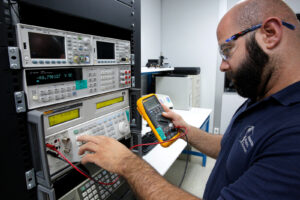
At International Process Solutions, we specialize in precise and traceable ultra low vacuum calibration services tailored for industries that demand the highest standards in measurement integrity. Our expertise spans a range of ultra-high vacuum (UHV) systems, supporting laboratories, semiconductor fabrication facilities, aerospace R&D environments, and metrology institutions. We operate within strict protocols to ensure confidence in your instrumentation and process reliability.
Understanding Ultra Low Vacuum and Its Calibration Needs
Ultra low vacuum, often synonymous with ultra-high vacuum (UHV), refers to pressure levels below 10⁻⁷ Torr, extending to ranges as low as 10⁻¹² Torr. Maintaining accuracy at these pressures is critical for sensitive scientific and industrial applications. The slightest deviation in vacuum readings can lead to compromised results, product defects, or equipment failure.
The need for meticulous calibration stems from the complex behavior of gases at these low pressures. Molecular flow dominates, and traditional pressure calibration techniques become ineffective. Instruments like ionization gauges, cold cathode gauges, and spinning rotor gauges must be calibrated using precise, controlled environments.
Primary Instruments Calibrated in Ultra Low Vacuum Ranges
We calibrate a comprehensive range of UHV instrumentation, including:
- Bayard-Alpert ionization gauges
- Hot and cold cathode gauges
- Capacitance manometers for overlapping pressure regions
- Spinning rotor gauges (SRG)
- Residual gas analyzers (RGAs)
- UHV pressure controllers
- Thermocouple gauges (for transition regions)
Each instrument is verified against high-accuracy NIST-traceable standards or intrinsic standards as required.
Our Ultra Low Vacuum Calibration Process
1. Pre-Calibration Assessment and Stabilization
We begin with a comprehensive visual inspection and stabilization procedure. Instruments are checked for contamination, filament degradation, or vacuum leaks. UHV systems are susceptible to outgassing and virtual leaks, so stabilization under controlled bake-out conditions is often required prior to calibration.
2. High-Precision Calibration Chambers
Calibration is performed in UHV-compatible stainless steel chambers outfitted with cryopumps, turbomolecular pumps, and ion pumps, allowing us to achieve base pressures below 10⁻¹⁰ Torr. These chambers are isolated from ambient conditions using gate valves, baffles, and ultra-clean assembly procedures.
3. Reference Instruments and Standards
We maintain primary and secondary reference gauges calibrated directly through national metrology institutes (NMIs). Our comparison methods follow ISO 3567 and ISO/TS 27865 standards for vacuum gauge calibration. Transfer standards are regularly validated and undergo drift evaluation to ensure continued accuracy.
4. Measurement Points and Range Mapping
Multiple calibration points are established across the vacuum range. For example, a typical ionization gauge may be mapped from 1×10⁻⁴ to 1×10⁻⁹ Torr, depending on the application. We adjust the vacuum level in precise increments using calibrated leak valves and dynamic expansion techniques to simulate real-world operating conditions.
5. Uncertainty Analysis and Traceability
All data is analyzed for measurement uncertainty, incorporating contributions from:
- Reference standard uncertainty
- Environmental stability (temperature, vibration, EM interference)
- Repeatability of the device under test (DUT)
- Resolution and linearity errors
We document complete uncertainty budgets, conforming to ISO/IEC 17025:2017 requirements. Every calibration result is fully traceable, supported by certificates and recorded data logs.
Industries We Serve with Ultra Low Vacuum Calibration
Semiconductor Manufacturing
Vacuum levels in etching, deposition, and ion implantation must be tightly regulated to avoid contamination and achieve thin film precision. We calibrate the full range of gauges used in process chambers, load locks, and transfer modules.
Aerospace and Satellite Engineering
Vacuum systems in satellite component testing, space simulation chambers, and propulsion systems rely on exact pressure monitoring. We ensure compliance with NASA, ESA, and DoD calibration standards.
National Laboratories and Research Institutions
Particle accelerators, electron microscopes, and quantum computing facilities require ultra-high vacuum environments. We provide service contracts for UHV calibration laboratories, supporting photon science, nuclear research, and materials engineering.
Pharmaceutical and Vacuum Drying Systems
Vacuum drying and lyophilization require controlled pressures for safe and efficient solvent removal. Although these applications typically operate at low and medium vacuums, overlapping instruments may still need verification at the ultra-low range due to shared infrastructure.
Benefits of Calibrating with International Process Solutions
ISO/IEC 17025 Accredited
Our lab is ISO/IEC 17025:2017 accredited, ensuring we meet the highest international standards for calibration competency, impartiality, and technical reliability.
On-Site and Off-Site Calibration Options
We offer both in-lab calibration in our clean, climate-controlled facility and on-site UHV calibration for systems that cannot be disassembled. Our mobile teams are equipped with portable vacuum standards and shielding equipment.
Fast Turnaround Times
We understand the critical nature of downtime in vacuum-dependent operations. That’s why we maintain an expedited process, offering rapid calibration turnaround without compromising measurement integrity.
Expert Technical Consultation
Our calibration services are supported by vacuum metrology experts who provide engineering guidance, troubleshooting, and equipment optimization recommendations. This consultative approach ensures your systems maintain peak performance between calibration cycles.
Detailed Calibration Reports
Each calibration includes:
- Device identification and condition assessment
- Calibration method and reference instrument details
- Full measurement data
- Environmental conditions
- Traceability and uncertainty analysis
- Recommendations for recalibration intervals
Reports are available in digital and hardcopy formats, compatible with audit and regulatory requirements.
Maintaining Calibration Integrity in UHV Systems
To extend the validity of ultra low vacuum calibration, we recommend:
- Regular leak checking using helium mass spectrometry
- Periodic bake-outs to eliminate virtual leaks and outgassing
- Routine zeroing and span checks of installed gauges
- Maintaining clean feedthroughs and eliminating hydrocarbon sources
- Using vacuum-compatible materials and minimizing elastomer seals in UHV zones
Schedule a Calibration with International Process Solutions
When accuracy at molecular-level pressures is essential, trust International Process Solutions to deliver calibrated confidence. Our advanced infrastructure, technical acumen, and commitment to precision make us the preferred partner for ultra low vacuum calibration across critical industries.
To request a quote or schedule service, contact our calibration team today. We’re ready to ensure your instrumentation performs flawlessly in even the most demanding vacuum environments.