
In regulated and performance-driven industries, equipment reliability, measurement accuracy, and operational continuity are non-negotiable. Organizations increasingly rely on predictive maintenance to reduce downtime while maintaining strict adherence to calibration requirements to ensure data integrity and compliance. A critical question naturally arises: which should come first—predictive maintenance or calibration?
At International Process Solutions, we approach this question from a practical, risk-based, and compliance-focused perspective. The answer is not theoretical; it directly impacts uptime, audit readiness, product quality, and total cost of ownership. Below, we provide a definitive, in-depth framework that clarifies sequencing, integration, and best practices—so organizations can implement both disciplines with confidence and precision.
Understanding Predictive Maintenance in Modern Operations
Predictive maintenance (PdM) leverages real-time and historical data to anticipate equipment degradation before failure occurs. By using sensor data, trend analysis, vibration monitoring, thermography, and advanced analytics, organizations can intervene at the optimal moment—neither too early nor too late.
Key characteristics of predictive maintenance include:
- Condition-based decision making
- Reduced unplanned downtime
- Extended asset life
- Optimized maintenance intervals
- Lower emergency repair costs
Predictive maintenance focuses on mechanical health, performance drift, and failure probability, providing visibility into when an asset is likely to deviate from acceptable operating parameters.
Defining Calibration and Its Critical Role
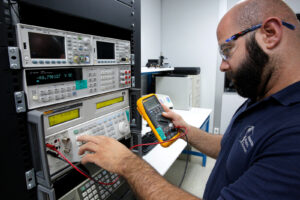
Calibration is the formal process of verifying and adjusting measurement instruments against traceable reference standards to ensure accuracy within specified tolerances. Unlike predictive maintenance, calibration is not optional—it is often mandated by regulatory frameworks such as ISO/IEC 17025, ISO 9001, FDA 21 CFR, GMP, and industry-specific quality systems.
Calibration ensures:
- Measurement accuracy
- Traceability to national or international standards
- Regulatory compliance
- Reliable data for decision-making
- Consistency across processes and locations
Calibration governs what data can be trusted, making it foundational to quality, safety, and compliance.
Predictive Maintenance vs. Calibration: A Functional Comparison
While both disciplines improve operational performance, their objectives and risk profiles differ significantly.
| Aspect | Predictive Maintenance | Calibration |
|---|---|---|
| Primary focus | Equipment condition | Measurement accuracy |
| Regulatory requirement | Often optional | Frequently mandatory |
| Data dependency | Uses sensor outputs | Validates sensor outputs |
| Timing flexibility | Adaptive | Fixed or compliance-driven |
| Risk of omission | Increased downtime | Invalid data and audit failures |
This comparison highlights a crucial reality: predictive maintenance relies on accurate measurements, while calibration does not rely on predictive maintenance to remain valid.
Which Comes First: The Definitive Answer
Calibration must come first.
At International Process Solutions, we treat calibration as the non-negotiable foundation upon which predictive maintenance is built. Without calibrated instruments, predictive maintenance insights become unreliable, misleading, or outright incorrect.
Predictive algorithms, condition thresholds, and trend analytics are only as accurate as the data feeding them. Uncalibrated sensors compromise the entire predictive maintenance strategy, creating false positives, missed failure indicators, and flawed decision-making.
Why Calibration Must Precede Predictive Maintenance
1. Data Integrity Is the Cornerstone
Predictive maintenance systems interpret changes in vibration, temperature, pressure, torque, voltage, and flow. If these values are skewed due to drift, wear, or sensor aging, the system cannot differentiate between normal variance and early failure indicators.
Calibration establishes measurement truth, ensuring predictive insights reflect actual equipment conditions.
2. Regulatory and Quality Risk Management
In pharmaceutical, aerospace, life sciences, energy, and manufacturing environments, uncalibrated instruments invalidate records. This includes condition monitoring data used to justify extended maintenance intervals or deferred repairs.
Calibration first ensures:
- Audit-ready documentation
- Defensible maintenance decisions
- Compliance with internal and external quality systems
3. Predictive Maintenance Threshold Accuracy
Alarm thresholds, alert limits, and degradation models are all defined numerically. Calibration aligns these thresholds with reality, preventing unnecessary shutdowns or overlooked faults.
An uncalibrated sensor may:
- Trigger maintenance too early, inflating costs
- Fail to detect early-stage degradation
- Mask safety-critical failures
4. Asset Life-Cycle Optimization
Calibration provides a baseline that allows predictive maintenance to extend asset life responsibly. Without accurate baselines, organizations risk running equipment beyond safe limits or retiring assets prematurely.
The Correct Operational Sequence
At International Process Solutions, we recommend the following proven sequence:
- Initial calibration at installation or commissioning
- Baseline performance data capture
- Deployment of predictive maintenance monitoring
- Ongoing calibration at defined intervals
- Predictive maintenance optimization using validated data
- Risk-based calibration interval refinement
This approach ensures continuous accuracy and operational intelligence, not isolated compliance or reactive maintenance.
How Predictive Maintenance Enhances Calibration Programs
Once calibration is firmly established, predictive maintenance becomes a powerful enhancement rather than a replacement.
Predictive maintenance supports calibration by:
- Identifying instrument drift trends
- Highlighting environmental stressors affecting accuracy
- Supporting risk-based calibration intervals
- Reducing unnecessary calibrations without increasing risk
- Prioritizing critical instruments for tighter control
When properly integrated, predictive maintenance allows calibration programs to become smarter, leaner, and more defensible.
Common Pitfalls When Predictive Maintenance Is Implemented First
Organizations that reverse the sequence often encounter:
- False confidence in flawed data
- Increased corrective actions after audits
- Unexplained discrepancies between systems
- Escalating maintenance costs
- Loss of trust in predictive analytics
These failures are rarely due to predictive maintenance itself—but rather to skipping foundational calibration discipline.
Industry-Specific Considerations
Pharmaceutical and Life Sciences
Calibration must precede predictive maintenance to ensure data integrity under GMP conditions. Predictive insights without traceable calibration are not acceptable during inspections.
Manufacturing and Industrial Automation
Calibration ensures sensor harmonization across production lines, enabling predictive maintenance models to scale accurately.
Energy, Utilities, and Oil & Gas
Predictive maintenance is essential, but calibrated pressure, flow, and temperature instruments are critical for safety, environmental compliance, and asset protection.
International Process Solutions’ Integrated Approach
At International Process Solutions, we deliver calibration-first predictive maintenance frameworks designed to support compliance, reliability, and long-term operational excellence.
Our approach includes:
- ISO/IEC 17025–aligned calibration services
- On-site and laboratory calibration
- Predictive maintenance readiness assessments
- Data validation and baseline development
- Integrated maintenance and calibration strategies
- Documentation that withstands audits and inspections
We do not treat calibration and predictive maintenance as competing philosophies. We implement them as complementary disciplines, sequenced correctly and aligned with operational risk.
The Strategic Advantage of Doing It Right
When calibration comes first and predictive maintenance follows, organizations gain:
- Accurate, trustworthy condition monitoring
- Reduced unplanned downtime
- Improved compliance posture
- Optimized maintenance budgets
- Extended asset lifespan
- Greater confidence in operational decisions
This structured integration transforms maintenance from a cost center into a strategic performance driver.
Foundation Before Forecast
Predictive maintenance delivers powerful foresight—but only when built on a foundation of calibrated, traceable, and defensible measurements. Calibration establishes trust. Predictive maintenance builds insight. Together, in the correct order, they create operational resilience and measurable competitive advantage.
At International Process Solutions, we ensure calibration always comes first—so predictive maintenance delivers results that are accurate, compliant, and actionable.